Benchmarking Recursion Speed in R, Python, and Julia
There are so many exciting things happening the world of statistical programming languages for data science. R, Python, and Julia each has great reasons to include in your toolbox. Arguing which one is best is akin to arguing over whether Spanish, Italian, or French is “better.” Our lab uses them all and we try to suit the tool to the project and its people.1
Although not typically used for data science applications, recursive functions offer a quick and easy (albeit limited) test of a programming language’s speed. The Fibonacci sequence is a sequence of numbers in which the next value equals the sum of the two previous values. Thus the sequence looks like
\[ F_n = 0, 1, 1, 2, 3, 5, 18, 13... \]
Calculating the \(N^{th}\) value of the sequence could be done iteratively using a for loop. For many programming languages, this is probably the fastest approach. Alternatively, a recursive approach — one in which a function calls itself again and again — also provides an elegant solution.
Let’s try to implement a recursive function to calculate the \(N^{th}\) value of the Fibonacci sequence in R, Python, and Julia. We’ll time each run and see how these approaches compare.
R
# Define recursion function for fibonacci sequence
fib <- function(n) {
  if (n == 0) return (0)
  if (n <= 2) return (1)
  return (fib(n - 1) + fib(n - 2))
}

# Define range of sequence to explore, 1 through 40
Ns = 0:40

# Estimate the time taken for each run
Ts = sapply(Ns, \(n) system.time(fib(n))[3])

# Plot the results
plot(Ns, Ts, type = "l",
     xlab = "N", ylab = "time (s)",
     col = "blue",
     main = "Recursive calculation of Fibonacci numbers (R)")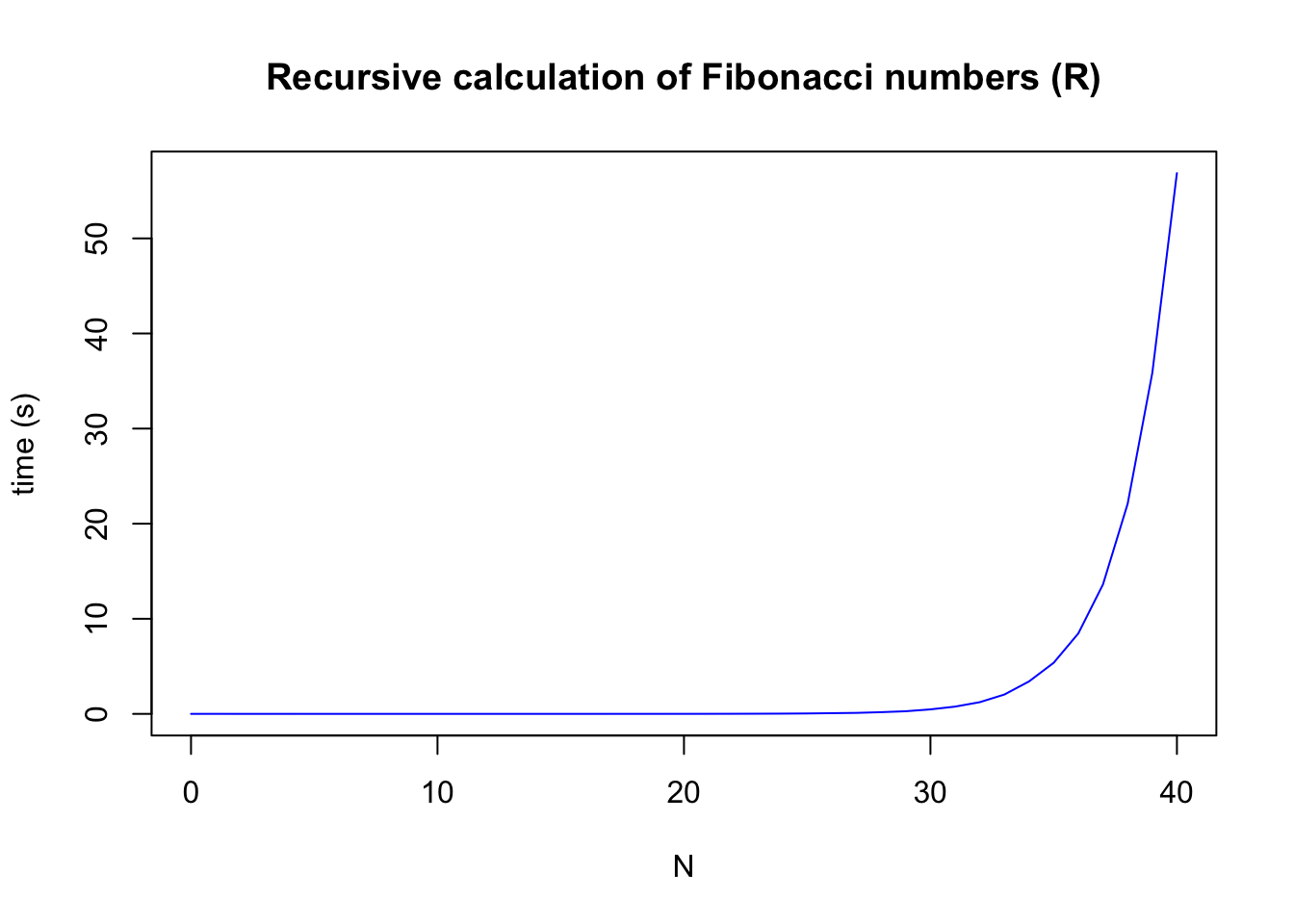
# Total time
print(paste0("Total time was ", sum(Ts), " seconds in R."))
## [1] "Total time was 150.873 seconds in R."Python
import matplotlib.pyplot as plt
from timeit import timeit

# Define recursion function for fibonacci sequence
def fib(n):
  if (n == 0):
    return 0
  elif (n <= 2):
    return 1
  else:
    return (fib(n - 1) + fib(n - 2))

# Define range of sequence to explore, 1 through 40
Ns = range(0,41)

# Estimate the time taken for each run
Ts = [timeit(lambda: fib(x), number = 1) for x in Ns]

# Plot the results
plt.plot(Ns, Ts, marker = "")
plt.xlabel("N")
plt.ylabel("time (s)")
plt.title("Recursive calculation of Fibonacci numbers (Python)")
plt.show()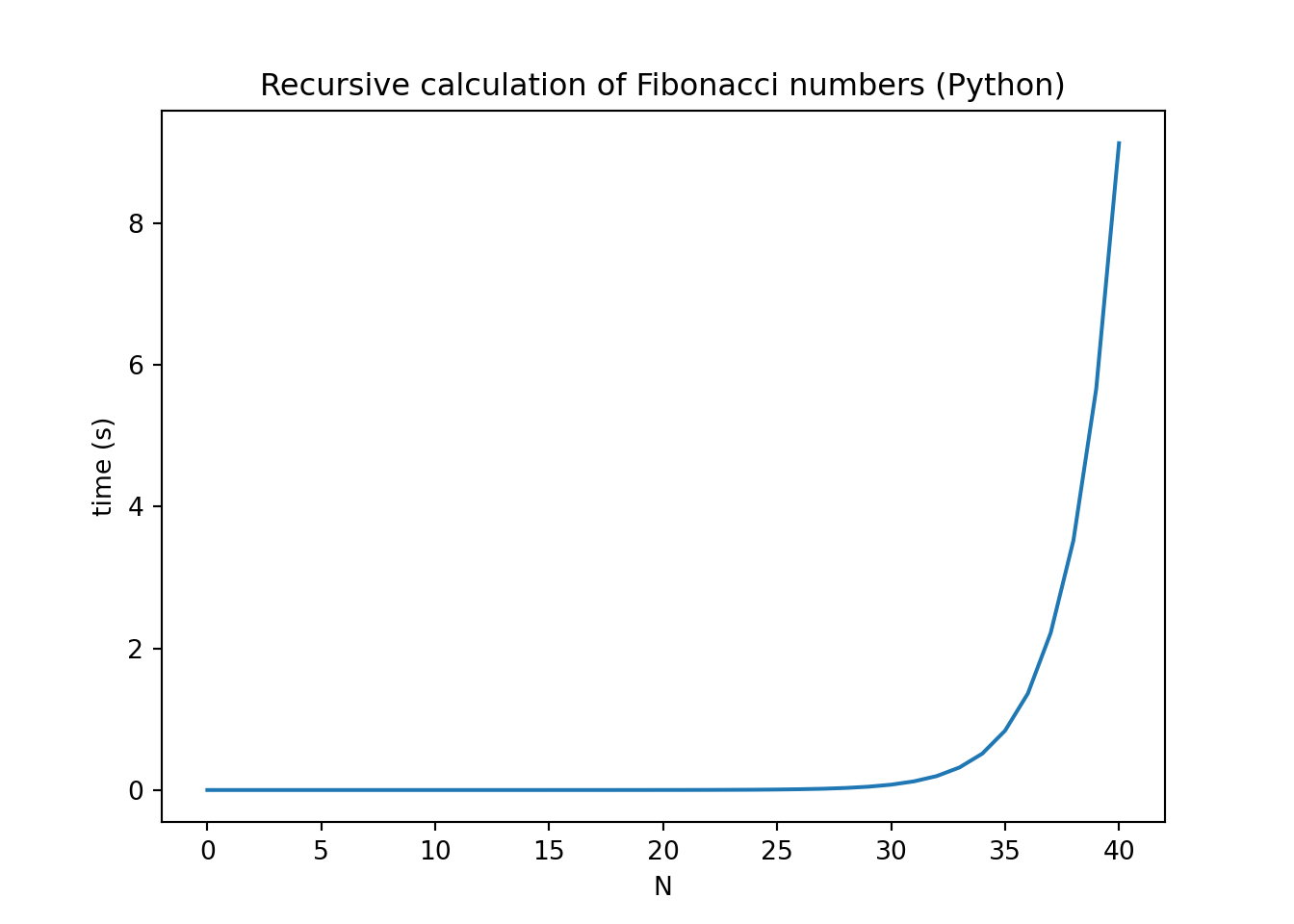
# Total time
print(f"Total time was {sum(Ts)} seconds in Python.")
## Total time was 24.07692269596737 seconds in Python.Julia
using Plots;

# Define recursion function for fibonacci sequence
fib = function(n)
  if n == 0
    return 0
  elseif n <= 2
    return 1
  else
    return fib(n - 1) + fib(n - 2)
  end
end;

# Define range of sequence to explore, 1 through 40
Ns = 0:40;

# Estimate the time taken for each run
Ts = [@elapsed fib(x) for x in Ns];

# Plot the results
plot(Ns, Ts,
     xlabel = "N", ylabel = "time (s)",
     title = "Recursive calculation of Fibonacci numbers (Julia)")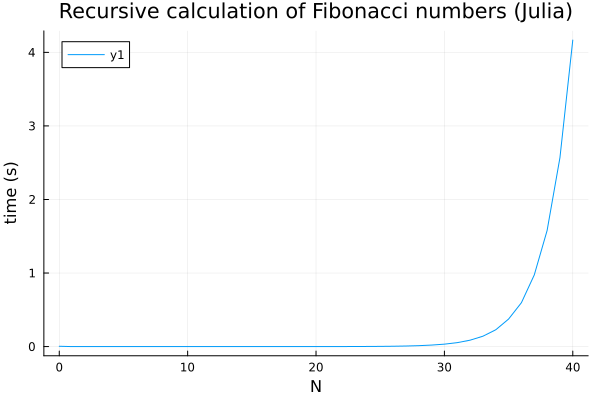
# Total time
print("Total time was $(sum(Ts)) seconds in Julia")
## Total time was 10.863438192 seconds in JuliaSummary
Calculating the first 40 elements of the Fibonacci sequence using a recursive algorithm took about 152, 24, and 11 seconds, for R, Python, and Julia, respectively. Overall pretty fast, and pretty significant differences among the languages. Notably, we didn’t account for start up time, time to check syntax, time to set up the environment, and other overheard. The R code was easily written in base R without the need for any additional packages. The Python environment was notably the slowest to set up and required installing matplotlib into a virtual environment that would run within Rstudio, which was used to render this document. The Julia example required installing and loading the Plots library, but this was already done as the same local environment I use was called by Rstudio without any additional configuration. Which language do you reach for first? When in Rome…
As an extra bonus, this notebook is a great example of how to use R, Python, and Julia together in a single notebook!↩︎

Assistant Professor of Medicine and Informatics
I am a pulmonary and critical care physician at the University of Pennsylvania Perelman School of Medicine, and core faculty member at the Palliative and Advanced Illness Research (PAIR) Center. My work seeks to translate innovations in artificial intelligence methods into bedside clinical decision support systems that alleviate uncertainty in critical clinical decisions. My research interests include clinical informatics, artificial intelligence, natural language processing, machine learning, population health, and pragmatic trials.